

PLASTIC PACKAGING QUALITY REFERENCE MANUAL
Plastic Bottle Surface Finishing & QC Inspection Guide
Identification of Eight Processes, Performance Testing, Food-Contact Requirements and AQL Acceptance
| INTENDED USERSPurchasing, IQC/QC, production and supplier quality teams | EDITIONEnglish · Updated August 2026 |
|---|
How to Identify Plastic Bottle Surface Finishes
The decoration on a PP, PE or PET plastic bottle may be produced by screen printing, heat transfer printing, UV printing, hot foil stamping or hydrographic printing. Its overall appearance and texture may also come from frosting, metallization or a soft-touch coating.
Purchasing teams, incoming quality inspectors and factory QC personnel can easily misidentify a process if they judge it by color alone. A more reliable approach is to examine the print edges, surface height, metallic reflection, coating boundaries, continuity across curved surfaces and tactile feel, and then confirm the result through adhesion, abrasion and alcohol-resistance tests.
Quick answer: first determine whether the finish is localized or full-surface; then compare edge definition, surface height, gloss and tactile feel. Confirm the suspected process against an approved sample and with a suitable test on a non-critical area.
Quick Identification Guide
A visibly raised ink layer with slight screen marks along the edges: most likely screen printing.
A multicolor image with photographic detail or gradients, sometimes with a visible transfer-layer boundary: most likely heat transfer printing.
Fine text, smooth gradients and a relatively hard cured ink layer, sometimes with a three-dimensional effect: most likely UV printing.
Localized gold, silver or holographic metallic reflection: usually hot foil stamping.
A uniform frosted finish covering the whole bottle without separate graphics: possibly abrasive blasting or a frosted coating.
A highly reflective, mirror-like metallic finish over the bottle: usually electroplating or vacuum metallization.
A matte bottle with a soft, non-slip tactile surface: usually a soft-touch coating.
Woodgrain, marble or camouflage continuously wrapping around complex curves: usually hydrographic printing.
Important: The ΔE limits, rubbing cycles, alcohol-wipe cycles and immersion times in this guide are recommended internal QC values. They are not universal national requirements. Define the method and acceptance criteria in the drawing, approved sample or quality agreement before production.
1. Scope and Recommended Inspection Environment
Substrates: PP, PE and PET plastic bottles.
Applications: incoming inspection, IQC/QC acceptance, supplier communication, process selection and first-article approval.
Inspection targets: printing ink, transfer layers, metallic coatings, clear coats and functional surface coatings.
| Item | Recommended condition |
|---|---|
| Ambient temperature | 23±2°C |
| Relative humidity | 50%±10% |
| Visual inspection light | D65 standard light source |
| Viewing distance | 20–30cm |
| Sample condition | Clean, fully cured and free from condensation, oil and contamination |
| Comparison reference | Customer-approved sample, limit sample, color standard or approved first article |
A color requirement should not simply state “ΔE≤3.0.” The agreement should specify whether ΔE*ab or ΔE00 is used, together with instrument geometry, aperture size, standard observer, number of measurements and calculation method.
2. Quick Comparison of Eight Surface Finishes
| Process | Visual and tactile characteristics | Photo/gradient capability | Typical applications |
|---|---|---|---|
| Screen printing | Slightly raised ink with dense solid colors; screen marks or minor edge serration may be visible under magnification | Not ideal for continuous-tone photos or soft gradients | Single-color logos, instructions and simple graphics |
| Heat transfer printing | Generally flat image; some systems leave a visible transfer-layer, clear-coat or print-area boundary | Supports photographs and multicolor gradients | Illustrations and large-area decoration |
| UV printing | Fine text and gradients; cured ink is relatively hard and may form controlled raised effects | Supports high-resolution graphics and 3D effects | Detailed logos, short runs and raised graphics |
| Hot foil stamping | Localized bright metallic reflection without the appearance of ordinary ink | No full-color photographic gradients | Gold/silver logos, borders and lines |
| Blasting/frosting | Even matte or finely textured finish over the whole bottle without separate graphics | Not applicable | Matte surfaces, defect masking and print-base preparation |
| Electroplating/metallization | Highly reflective metallic appearance over the whole bottle or a large area | Not applicable | Gold, silver, rose gold and gunmetal finishes |
| Soft-touch coating | Matte appearance with a soft, smooth and non-slip feel | Not applicable | Soft-touch and fingerprint-resistant packaging |
| Hydrographic printing | Woodgrain, marble or camouflage continuously covering complex shapes | Continuous decorative patterns | Full-surface decoration on curved parts |
A visible transparent film edge should not be the only criterion for identifying heat transfer printing. Different transfer films, release layers and protective coatings behave differently. Dye sublimation also requires a compatible substrate or surface coating and should not automatically be treated as identical to conventional bottle heat transfer printing.
3. Recommended Identification Sequence
Step 1: Determine Whether the Finish Is Localized or Full-Surface
If only a logo, text or specific graphic area is decorated, focus on screen printing, heat transfer printing, UV printing and foil stamping. If the entire bottle has a consistent frosted, metallic or soft-touch appearance, focus on frosting, metallization and soft-touch coating. Continuous patterns over shoulders, grooves and complex curves indicate hydrographic printing.
Step 2: Examine Graphic Edges and Surface Height
Thick solid-color ink: more likely screen printing.
Smooth edges with complex colors: more likely UV or heat transfer printing.
Metallic foil reflection rather than metallic-colored ink: more likely foil stamping.
A protective clear coat with seams or stretched patterns: more likely hydrographic printing.
Step 3: Test a Non-Critical Area
A magnifier, adhesive tape or alcohol may be used for localized verification. These tests may damage the sample, so obtain customer authorization and retain untested samples for comparison or dispute resolution.
4. Screen Printing Appearance and Performance Inspection
Screen printing process control may refer to GB/T 17934.5-2021. Ink adhesion may refer to GB/T 13217.7-2023. These documents provide process-control or test methods and do not automatically replace the acceptance limits agreed between buyer and supplier.
4.1 Appearance Defect Classification
CR — Critical: affects regulatory compliance, safety, essential information or basic function.
MAJ — Major: has an obvious effect on appearance, function or customer acceptance.
MIN — Minor: does not affect function and is not obvious under normal viewing conditions.
| Inspection item | Recommended acceptance requirement | Defect classification reference |
|---|---|---|
| Text and graphics | Match the approved sample; correct content; clean lines; no incorrect, missing or reverse print, obvious ghosting or trailing | Incorrect or unreadable safety information may be CR; obvious broken text or missing graphics may be MAJ |
| Color difference | ΔE≤3.0 under the agreed formula and conditions, with no obvious visual deviation under D65 | Obvious deviation may be MAJ; a difference visible only during close comparison may be MIN |
| Pinholes, splashes and dirt | No obvious defect in critical areas; non-critical blank areas may allow isolated defects ≤0.2mm, no more than two and not concentrated | Dense pinholes, widespread splashes or obvious contamination may be MAJ |
| Print position | Recommended ±0.8mm for standard bottles and ±0.5mm for premium packaging | Deviation beyond the drawing or approved-sample tolerance may be MAJ |
| Ink-layer condition | Uniform thickness without accumulation, wrinkling, show-through or obvious unevenness | Localized clumping, substrate exposure or obvious variation may be MAJ |
Ink-film thickness depends on screen mesh, emulsion thickness, squeegee parameters and ink system. A range such as 10–30μm should only be an acceptance limit when explicitly defined in the drawing or agreement.
4.2 Adhesion Testing
For printing ink, select an appropriate GB/T 13217.7-2023 method based on the ink and substrate.
For clear coats or overall coatings, GB/T 9286-2021 may be used after confirming suitability.
The cutter must penetrate to the substrate; spacing depends on coating thickness and substrate type.
GB/T 9286 uses Class 0 to Class 5, with Class 0 being best. The agreement may require Class 0 or accept Class 1 or better.
Use the least-curved bottle area or a process test panel prepared under the same conditions.
“3M 600 tape, 90-degree peel and three repeated pulls” is a company method, not the standard GB/T 9286 procedure.
4.3 Abrasion, Alcohol and Warm-Water Resistance
| Test | Recommended conditions | Recommended acceptance criteria |
|---|---|---|
| Production-line rub check | Approx. 3kg thumb pressure, 15 reciprocating rubs | No obvious ink loss, peeling or substrate exposure |
| Eraser abrasion | 500g load, 100 reciprocating cycles | No wear-through or large-area flaking; text remains legible |
| Alcohol resistance | Lint-free cloth with 75% alcohol, approx. 1.5kg pressure, 30 cycles | No ink dissolution, peeling or obvious fading |
| Warm-water resistance | Immerse in 45°C water for 2 hours, then cool and dry | No blistering, peeling or significant adhesion loss |
| Artificial weathering | Agreed xenon-arc conditions and a period such as 500 hours | No obvious chalking or cracking; color within agreed limit |
Weathering note: Artificial weathering may refer to GB/T 16422.2-2022. “500 hours under a xenon lamp” is incomplete without the optical filter, irradiance, black-standard temperature, humidity or water-spray cycle and evaluation interval.
5. Inspection Requirements for the Other Seven Processes
5.1 Heat Transfer Printing
The graphic must be complete and flat, with no obvious bubbles, wrinkles, lifted edges, ghosting or blurred edges. Color must match the approved sample.
No large-area peeling or delamination after tape testing.
No obvious fading or edge lifting after 20 wipes with 75% alcohol.
No substrate exposure after 80 abrasion cycles under a 500g load.
No lifting, delamination or discoloration after 2 hours in 45°C water.
5.2 UV Printing
Edges must be sharp, small text clear and gradients smooth. No missing print, bubbles, pinholes or abnormal buildup. Raised UV areas must be uniform.
Cross-cut adhesion target: Class 0, using the agreed method.
No color loss or peeling after 50 wipes with 75% alcohol.
No wear-through or whitening after 150 cycles under a 500g load.
Use the actual product formula or a specified simulant for compatibility testing.
5.3 Hot, Silver and Holographic Foil Stamping
Metallic gloss must be uniform, with no missing foil, over-stamping, broken lines, bubbles, blackening or obvious pinholes. Recommended position tolerance: ±0.5mm.
No obvious foil removal after tape testing.
No large-area foil loss after light fingernail scratching.
No obvious whitening or substrate exposure after 50 cycles under a 500g load.
5.4 Abrasive Blasting or Frosting
The frosted surface must be uniform and fine, without localized gloss, coarse patches, obvious scratches, shade variation or impact marks.
Consistent tactile feel over the whole surface.
No abnormal powder or particle shedding after dry wiping.
Verify surface energy and ink adhesion before further printing.
Confirm whether the effect comes from blasting, mold texture or sprayed frosting.
5.5 Electroplating or Vacuum Metallization
The coating must be uniform and bright, without obvious pinholes, pitting, yellowing, blackening, flow marks or color variation. The clear coat must be free from orange peel, blistering and show-through.
No peeling or delamination after an agreed cross-cut or tape test.
Specify neutral salt-spray duration where corrosion resistance is required.
Confirm whether salt-spray testing suits the actual vacuum-metallized layer structure.
5.6 Soft-Touch, Rubberized or Skin-Feel Coating
Matte color and soft feel must be uniform, without runs, particles, show-through, paint accumulation, stickiness or hardened areas.
Cross-cut adhesion: Class 1 or better.
No damage, show-through or obvious whitening after 100 cycles under a 500g load.
No peeling or significant gloss loss after 20 wipes with 75% alcohol.
Add high-temperature/high-humidity or accelerated aging to identify long-term tackiness.
5.7 Hydrographic Printing
The pattern must be complete and continuous, without obvious stretching, misalignment, seams, bubbles, craters, show-through, runs or floating film. Registered graphics may use a ±0.8mm position tolerance.
Adhesion: cut through the clear coat and transfer layer; Class 1 or better, with interlayer delamination causing rejection.
Abrasion: 500g load for 100 cycles; no show-through or obvious whitening.
Alcohol: 75% alcohol, approx. 1.5kg pressure, 30 wipes; no fading or peeling.
Warm water: 2 hours at 45°C; no blistering, delamination or discoloration.
6. Surface Process Selection Guide
| Product requirement | Recommended process |
|---|---|
| High-volume production, single-color logo and cost control | Screen printing |
| Photographs, gradients and large multicolor graphics | Heat transfer printing |
| Small batches, rapid prototyping, fine graphics or raised effects | UV printing |
| Localized premium metallic decoration | Hot foil stamping |
| Full-bottle matte finish or substrate-defect masking | Abrasive blasting or frosting |
| Full-bottle mirror-like metallic appearance | Electroplating or vacuum metallization |
| Non-slip, fingerprint-resistant soft tactile finish | Soft-touch coating |
| Woodgrain, marble or camouflage over complex curves | Hydrographic printing |
Final process selection should also consider order volume, bottle curvature, substrate surface energy, filling contents, transport abrasion, service temperature and recycling requirements. PP and PE often require flame, corona or plasma pretreatment. Conduct adhesion testing only after the ink has fully cured.
Custom Surface Finishing Support from Wuxi Afshan Packaging Co., Ltd.
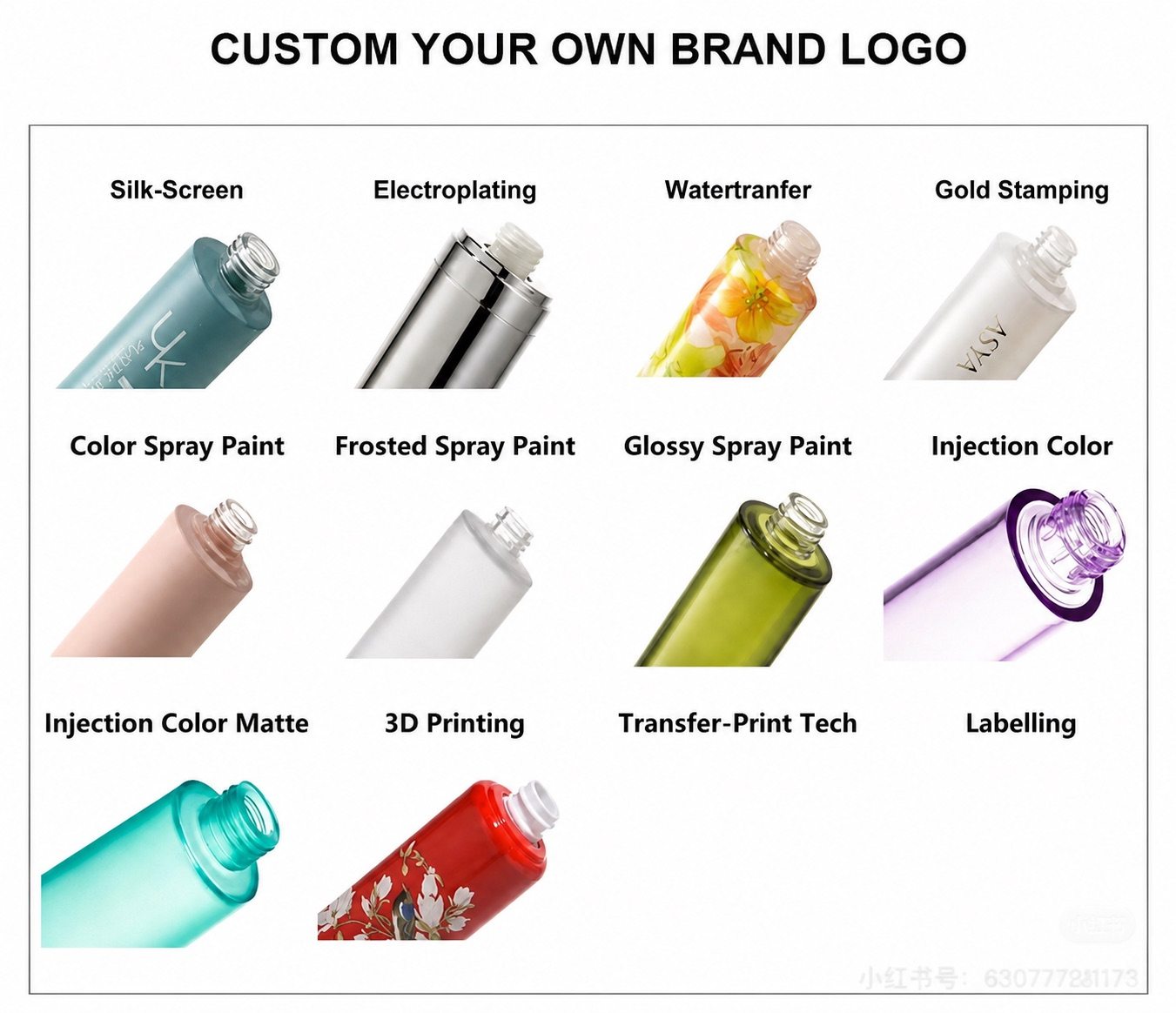
Wuxi Afshan Packaging Co., Ltd. provides customized surface-finishing and decoration solutions for plastic packaging containers. Depending on the bottle resin, geometry, artwork and target market, available options can include custom injection colors, matte or glossy spray coatings, frosting, silk-screen printing, UV printing, heat-transfer or water-transfer decoration, hot foil stamping, labeling and selected metallized finishes.
From artwork review and color matching to approved samples and mass-production quality control, our team can help define the finish, inspection method and acceptance criteria before production. We recommend confirming the final specification through pre-production samples and compatibility testing with the intended product formula.
7. Food-Contact Plastic Bottle Requirements
PP, PE and PET bottles intended for food contact should be evaluated according to GB 4806.7-2023. Printing inks used on food-contact materials and articles should also address GB 4806.14-2023; it is no longer accurate to state only that the ink complies with GB 4806.7.
Do not apply conventional printing ink to the bottle surface that directly contacts food.
If direct-contact printing is required, use an appropriate ink system and conduct dedicated migration and compliance assessments.
Evaluate migration, permeation and set-off risks affecting the food-contact surface.
Require declarations of compliance and necessary reports for inks, coatings and raw materials.
Select migration-test conditions according to expected food type, contact temperature and duration.
Compliance note: External-surface printing is not automatically compliant. Bottle-wall structure, ink chemistry, curing condition and actual conditions of use must still be evaluated.
8. Setting Up AQL Sampling Inspection
As of this guide’s update, the current international edition is ISO 2859-1:2026. It provides AQL-indexed sampling schemes for lot-by-lot inspection by attributes and replaces the 1999 edition.
| Defect/item | Recommended control |
|---|---|
| Critical defects | Ac=0, Re=1: reject the lot or escalate to 100% inspection if one is found |
| Major defects | AQL 0.65 |
| Minor defects | AQL 2.5 |
| General inspection level | General Inspection Level II |
| Sampling plan | Normal inspection and single sampling, with tightened, reduced or discontinuation rules applied according to quality history |
Statistical note: “Critical defect: AQL=0” is not precise. Specify Ac=0 and Re=1, with 100% inspection where required. Actual sample size also depends on lot size, inspection level, code letter, normal/tightened/reduced status, sampling type and the contract-specified edition.
Abrasion, alcohol, immersion and weathering tests are destructive or time-consuming. They should normally use separate fixed sample quantities and retest rules rather than relying entirely on appearance-inspection AQL.
9. Recommended Incoming and Production QC Workflow
Review the purchase order, drawing, color standard, approved sample and specified process.
Confirm whether the substrate is PP, PE or PET and identify the surface pretreatment.
Inspect overall appearance, color and print position under D65 lighting.
Record defects according to CR, MAJ and MIN classifications.
Determine the AQL sample size from lot size and inspection level.
Conduct specified adhesion, abrasion, alcohol or product-compatibility tests.
Retain photographs, test parameters, sample lot number, ink lot number and results.
Approve the first article before mass production and set a risk-based in-process inspection frequency.
Inspection every two hours is a common internal rule rather than a universal ISO requirement. Adjust the interval according to production volume, equipment stability, artwork changes and historical defect rates.
10. Frequently Asked Questions
Where should I look first when distinguishing screen printing from UV printing?
Begin with the text and graphic edges. Screen printing generally produces a thicker solid ink layer and may show screen characteristics under magnification. UV printing usually provides finer small text, dots and gradients, with a harder cured surface.
Does heat transfer printing always have a visible transparent film edge?
No. The result depends on film structure, release system and protective coating. Some products have a visible boundary, while others retain only the ink or clear coat.
What does Class 1 cross-cut adhesion mean?
GB/T 9286 uses Class 0 to Class 5, with Class 0 being the best. Class 1 indicates a small amount of detachment around cut intersections. It is an empirical classification, not a direct numerical adhesion-strength measurement.
Why are PP and PE bottles more likely to experience adhesion failure than PET?
PP and PE have relatively low surface energy, making it more difficult for ink to wet and bond. Insufficient pretreatment, excessive delay after treatment or an incompatible ink system may cause failure.
How many alcohol-wipe cycles are required?
There is no single number for all plastic bottles. Requirements such as 20, 30 or 50 cycles are common internal specifications and should reflect actual exposure risk and customer requirements.
Does AQL 2.5 mean that 2.5% defective products are allowed in every lot?
No. AQL is used to select a statistical sampling plan. It does not allow a fixed percentage of defects and cannot be interpreted without lot size, sample size and acceptance number.
Conclusion
Plastic bottle surface finishing cannot be reliably inspected based only on whether the product “looks acceptable.” An effective QC specification should include process identification, limit samples, defect classification, adhesion, abrasion resistance, chemical resistance, filling-product compatibility and sampling rules.
Defining the substrate, process, color, positional tolerance, test method, parameters and acceptance criteria before production is far more effective than debating whether ink loss is acceptable after a problem occurs.
Standards and References
GB/T 17934.5-2021 — Screen printing process control
GB/T 13217.7-2023 — Ink adhesion test method
GB/T 9286-2021 — Paints and varnishes cross-cut test
GB/T 16422.2-2022 — Xenon-arc exposure method for plastics
GB 4806.7-2023 and GB 4806.14-2023 — National food-safety standards
ISO 2859-1:2026 — Sampling procedures for inspection by attributes
Google Search Central — Creating helpful, reliable, people-first content